
- TL;DR — The Essential Facts about mushrooms in Bali
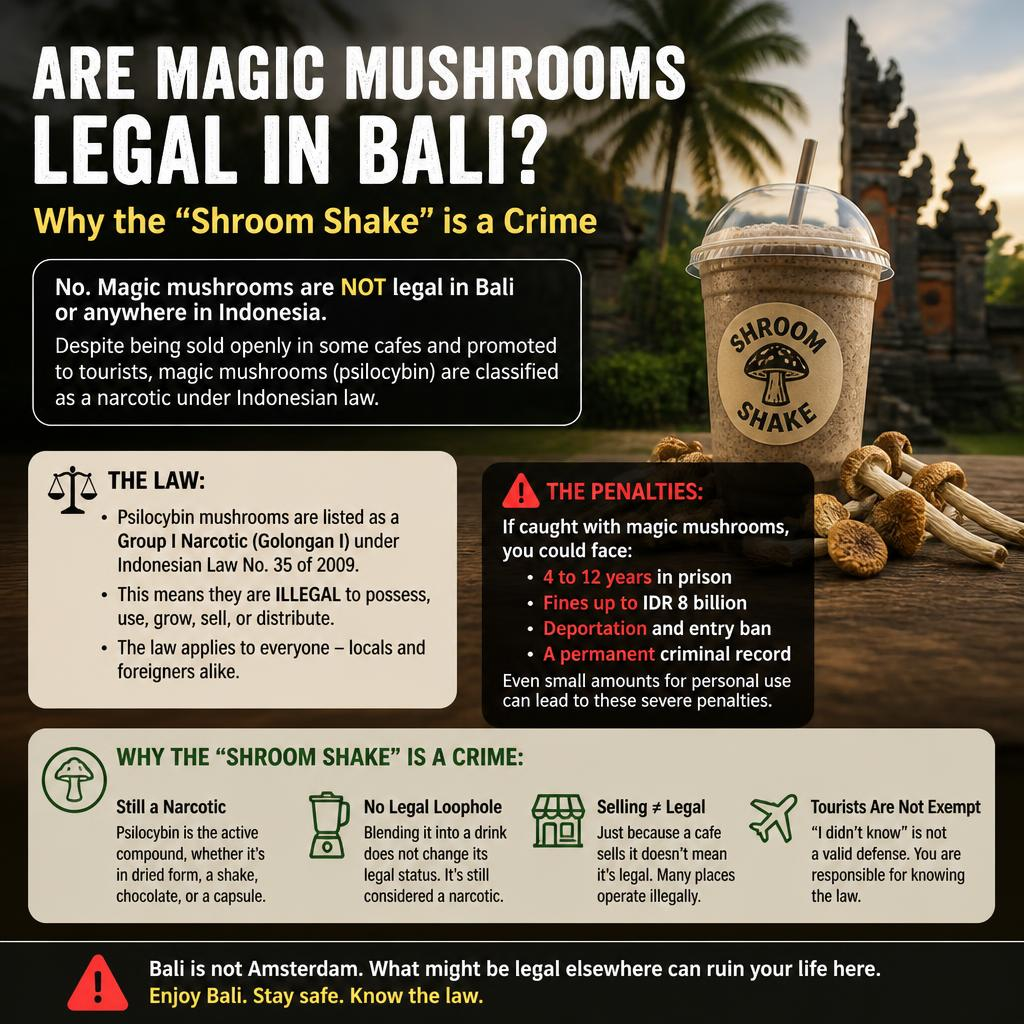
- Psilocybin (magic mushrooms) is a Group I Narcotic in Bali, Indonesia — the same legal classification as heroin. There is no grey area.
- The “shroom shake” sold at certain Canggu cafés and Gili Islands warungs is not a legal grey area product. It is a sold narcotic. Both buyer and seller are committing a criminal offence.
- Indonesian police conducted major undercover sting operations in 2025–2026 specifically targeting tourist venues selling psilocybin in Canggu, Uluwatu, and the Gili Islands.
- Penalties for possession: 4–12 years prison. For trafficking: 5–15 years, up to life or death penalty for large quantities.
- Arrest typically leads to immediate detention, trial, imprisonment, deportation, and a permanent ban on re-entry to Indonesia.
Magic Mushrooms in Bali
For a period stretching roughly from the late 2000s through the late 2010s, magic mushrooms — referred to by tourists as bali shrooms, bali mushrooms, or simply “the shakes” — occupied an unusual position in Bali’s tourist ecosystem. Certain warungs (small local eateries) and beach shacks — particularly in the Gili Islands (technically part of Lombok / West Nusa Tenggara rather than Bali, though frequently visited as part of a Bali trip) and in pockets of Bali’s surf and backpacker scenes in Seminyak, Canggu, and Ubud — openly sold psilocybin mushrooms blended into smoothies and shakes. The product was listed openly, if euphemistically, on hand-written menus. The sellers were not hiding.
This open commercial activity created a powerful and entirely false impression: if it’s sold openly, it must be at least tolerated. Travel forum recommendations, social media posts about magic mushrooms in Bali and Lombok, and the survivorship bias of tourists who consumed psilocybin and returned home without incident reinforced this impression. Today, tourists who search for “magic mushrooms in Bali,” “shrooms in Bali,” or “bali magic mushroom” still surface this outdated content — and the consequences of acting on it have never been more severe.
The “Grey Area” Myth: Where It Came From
What the myth missed — fatally, for those who acted on it — was the mechanism of tolerance. The open sales were not a function of legal permissiveness. They were a function of enforcement prioritisation. Indonesian police, particularly in the earlier period, directed their narcotics enforcement resources primarily at harder drugs (heroin, methamphetamine) flowing through major trafficking channels. Small-scale psilocybin sales to tourists in isolated beach warungs were not the primary target. But not being the primary target is not the same as being legal, tolerated, or safe.
By 2023–2024, the enforcement calculus shifted dramatically. International media coverage of Bali’s drug scene, pressure from the Indonesian government to protect the country’s increasingly premium tourism reputation, and the specific attention of the National Narcotics Board (Badan Narkotika Nasional / BNN) to the “shroom shake” phenomenon led to a significant escalation in psilocybin-targeted enforcement. By 2025–2026, the era of open mushroom sales in tourist venues was over — replaced by active, targeted, undercover operations.
The Legal Classification: Psilocybin Under Indonesian Law
Are magic mushrooms legal in Bali? Are mushrooms in Bali illegal? Is psilocybin legal anywhere in Indonesia — including Lombok or the Gili Islands? The answer to all of these questions is identical and legally unambiguous: no. Here is the exact legal framework.
There is no ambiguity in Indonesian law. Psilocybin and psilocin — the psychoactive compounds found in magic mushrooms (Psilocybe cubensis and related species) — are listed under Schedule I (Group I Narcotics) of Law No. 35 of 2009 on Narcotics (UU 35/2009), Indonesia’s principal narcotics legislation. This classification is confirmed by the Ministry of Health (Kemenkes RI), which maintains the official narcotics schedule, and is actively enforced by the National Narcotics Board (BNN).
Group I Narcotics in Indonesia are defined as substances that:
- Have a very high potential for abuse and addiction
- Are not accepted for medical or therapeutic use in Indonesia
- Are against the law for production, distribution, possession, or use except for very limited, licensed scientific research purposes
Alongside psilocybin, Group I includes heroin (diacetylmorphine), cocaine, MDMA (ecstasy), methamphetamine, cannabis, and LSD. The fact that researchers currently study psilocybin for therapeutic applications in the United States, Australia, and several European countries does not change Indonesian law. Indonesia is a sovereign nation that makes its own classification decisions, and it has not recognized any change in psilocybin’s legal status.
The raw mushroom — sold fresh, dried, ground into powder, or blended into a shake — is the same substance legally as any other psilocybin product. The “it’s just a mushroom, it grows naturally” argument has no legal standing in Indonesia. Many naturally occurring substances are classified as controlled narcotics worldwide, and Indonesia’s law makes no distinction.
The “Shroom Shake”: What It Is and Why It Is Criminal
The “shroom shake” — a smoothie or milkshake blended with fresh or dried psilocybin mushrooms, typically mixed with fruit, milk, or chocolate to mask the bitter taste — became a signature product of the Gili Islands tourism scene in particular, and appeared at certain venues in Canggu, Seminyak, Uluwatu, Ubud, and Amed in Bali proper. It was usually euphemistically listed as a “special shake,” a “magic shake,” a “happy shake,” a “mushroom smoothie,” a “mushroom milkshake,” or locally known as “the shakes.” Regardless of the name on the menu — magic mushroom shake, bali mushroom shake, mushroom shakes, shroom shake, or mushroom drink — the legal reality is identical. The species most commonly used was Psilocybe cubensis, cultivated locally or sourced from Lombok, though Indonesian law prohibits all psilocybin-containing fungi regardless of species or origin.
From a legal standpoint, every element of the shroom shake supply chain is criminal:
- The farmer who grows the mushrooms is cultivating a Group I Narcotic — Article 111 UU 35/2009
- The supplier who transports them to the vendor is trafficking a Group I Narcotic — Article 114 UU 35/2009
- The warung owner who blends them into a drink and sells them is distributing a Group I Narcotic — Article 114 UU 35/2009
- The tourist who purchases and consumes the shake is using a Group I Narcotic — Article 127 UU 35/2009
Every party in this chain is committing a criminal offence. The tourist who orders a “special shake” believing it to be a quirky local experience is, in the eyes of Indonesian law, a narcotics user. If the investigation reveals that the tourist purchased multiple shakes across multiple days, prosecutors may argue distribution-level involvement.
2025–2026 Undercover Sting Operations: What Happened
The 2025–2026 enforcement period marked a qualitative shift in how Indonesian authorities approached the psilocybin-in-tourism problem. The BNN and Bali’s Polda (Provincial Police) moved from reactive enforcement (arresting vendors when complaints were received) to proactive, undercover sting operations specifically targeting tourist venues suspected of selling psilocybin products.
The operations were concentrated in three key areas. The BNN’s official narcotics enforcement directorate publicly confirmed the escalation in tourist-zone enforcement operations following pressure from community and religious groups on the island:
Canggu
Police targeted multiple venues in Canggu, particularly along the Echo Beach and Batu Bolong corridor, during a series of coordinated sting operations that began in mid-2025. Undercover officers posing as tourists entered venues, ordered special shakes from menus, and upon taking possession of the product and confirming the presence of psilocybin via field test, made simultaneous arrests of venue staff. In several operations, police also detained and questioned foreign tourists at the venues and charged some of them as users under Article 127.
Ulu watu
Police targeted the Uluwatu cliff area—popular with surfers and known for its beach clubs and informal beach bars—in a separate series of operations aimed at disrupting the supply chain. Arrests included both local sellers and, notably, foreign nationals involved in the local supply chain who believed their involvement was too small-scale to attract enforcement attention.
Gili Islands
While technically outside Bali province, the Gili Islands (administered by West Nusa Tenggara / Lombok) experienced the most significant enforcement action of this period. Coordinated BNN and West Nusa Tenggara Police operations in 2025 resulted in the closure of multiple psilocybin-selling venues, the arrest of dozens of local vendors, and the detention of a number of foreign tourists who happened to be in the wrong place at the wrong time. Police designed the operations to dismantle the supply chain that had made the “shroom shake” a fixture of the Gili Islands for more than a decade.
How Indonesian Police Use Decoy Buyers
The undercover sting methodology used by Indonesian narcotics police is important to understand, because it fundamentally changes the risk calculation for any tourist considering purchasing psilocybin products in Bali or the wider region.
Indonesian narcotics authorities can use undercover operations and “controlled purchases,” in which an undercover officer buys a suspected narcotic from a vendor to establish evidence of an offence. Indonesian law recognizes this investigative technique, and authorities have used it in narcotics cases.
The practical implications for tourists:
- The person who approaches you and offers to sell magic mushrooms may be a police officer or a police informant. This is not paranoia — it is documented operational procedure. Our complete scam guide details how these police-informant setups work across Bali.
- The “local friend” who recommends a venue selling shroom shakes may be directing you into an environment under active surveillance.
- The vendor who sells to you openly and casually may be doing so under prior arrangement with law enforcement as an informant seeking to reduce their own liability.
- Police may arrest you after the transaction rather than during it. You may consume the product and face arrest hours later or the following day at a checkpoint or your accommodation, based on evidence that police gathered during the operation.
The key takeaway is that the visibility and apparent openness of psilocybin sales at certain venues is not a reliable indicator of safety. Active surveillance means the most “open” vendors may be the most actively monitored ones.
The Gili Islands Situation
The Gili Islands—Gili Trawangan, Gili Meno, and Gili Air—fall under Lombok’s West Nusa Tenggara province, not Bali. Tourists often visit them during extended Bali trips and travel there by fast boat from Bali’s Padang Bai or Amed ports. Throughout much of the 2010s, Gili Trawangan became synonymous with openly sold mushroom shakes—the “Gili T mushrooms” phenomenon that generated thousands of travel forum posts, social media recommendations, and word-of-mouth referrals. Vendors marketed these products as “Gili Trawangan magic smoothies,” “Gili mushroom shakes,” or simply “magic mushrooms on Gili T,” but Indonesian national law treated their sale as a serious crime throughout that decade. Lombok magic mushrooms and all psilocybin products across the entire Nusa Tenggara region are subject to the same national prohibition.
Indonesian narcotics law applies
The same Indonesian narcotics law applies to the Gili Islands as to Bali — UU 35/2009 is national law. However, Gili’s shroom trade grew from geographic isolation and limited local policing, not from any legal exception. Documented 2024 enforcement operations in Gili Trawangan led police to arrest bar managers and mushroom suppliers, whom prosecutors charged under narcotics trafficking provisions rather than minor possession laws. Moreover, 2025 operations dismantled supply chains and produced major arrests of foreign nationals linked to Gili Trawangan’s drug trade.
However, Indonesian law never legalized mushroom products, while authorities have increasingly targeted the informal trade since 2024. Any venue or individual still offering a gili mushroom shake or magic mushroom shake on Gili T is operating under active police surveillance. You, as the buyer, face identical criminal charges to the seller.
The Real Penalties Under Indonesian Law
Under UU 35/2009, psilocybin-related offences are treated identically to other Group I narcotics offences:
- Article 127 — Personal use: Minimum 1 year, maximum 4 years imprisonment. However, a judge may allow rehabilitation diversion, but qualified legal counsel must argue for it, and approval remains uncertain.
- Article 111 — Possession: Minimum 4 years, maximum 12 years imprisonment, plus fine up to IDR 800 million (~USD 50,000). If the quantity exceeds 1 kilogram or 5 plants: minimum 5 years, maximum 20 years or life imprisonment.
- Article 114 — Distribution/trafficking: Minimum 5 years, maximum 15 years imprisonment. For quantities exceeding 1 kilogram: minimum 10 years, maximum life imprisonment or the death penalty.
The quantity thresholds that trigger enhanced penalties are important. Tourists carrying personal supplies of dried mushrooms may find their amount exceeds statutory thresholds, triggering trafficking penalties instead. Dried psilocybin mushrooms are dense — a seemingly small bag can weigh more than a tourist expects.
Deportation and Permanent Blocklisting
Beyond imprisonment, foreigners convicted of narcotics offences in Indonesia may face two additional permanent consequences affecting their lives.
Deportation: After serving a custodial sentence, foreign nationals may face deportation to their country of origin. Indonesian immigration authorities handle deportation under applicable immigration rules following a narcotics conviction.
Permanent entry ban (penangkalan). The Directorate General of Immigration (Dirjen Imigrasi) maintains a denylist (Daftar Penangkalan) of individuals barred from entering Indonesia. Narcotics convictions result in permanent blocklisting. This means you cannot return to Indonesia — including Bali — for the rest of your life. Indonesian immigration law allows lifetime bans for foreigners whose offences seriously threaten public order, including narcotics trafficking.
For many tourists, the entry ban is in some ways the most devastating long-term consequence of all. Bali becomes permanently inaccessible. For those who have built lives, businesses, relationships, or retirement plans in Bali, this is a life-altering, irreversible outcome.
Why Tourists Continue to Get Caught
Given everything documented above, why do tourists continue to be arrested for psilocybin in Bali? The answers are consistent across case after case. Tourists searching for Bali mushroom shakes or mushroom laws often find outdated forum posts instead of current legal information.
- Outdated information from travel forums. TripAdvisor reviews, Facebook groups, and Reddit threads often share outdated recommendations for shroom venues, so verify current information. However, the 2015 review praising “magic shakes at a Gili T warung” remains searchable in 2026, despite major enforcement changes.
- Overconfidence based on friends’ experiences. “My friend came here five years ago and did shrooms on the beach every night and nothing happened.” Survivorship bias. The enforcement escalation happened primarily in 2024–2026. Past impunity does not predict current risk.
- Misreading vendor openness as legal signal: As discussed, the visibility of a vendor does not indicate safety. Active surveillance means the most visible vendors are often the most monitored.
- The “it’s just a mushroom” rationalisation: The naturalness of psilocybin mushrooms as organisms creates a psychological minimisation of legal risk. Indonesian law does not share this rationalisation.
- Not reading safety guides: A clear travel safety briefing explains the current legal reality and, therefore, helps tourists avoid serious legal consequences abroad.
What You Can Do Instead
Bali is one of the most genuinely consciousness-expanding destinations on earth — through entirely legal means. The spiritual and psychological transformation that many travellers seek from psychedelics is available through legitimate, deeply powerful Balinese modalities. Whether you choose a wellness retreat, romantic trip, or solo adventure, Bali offers experiences for every traveler.
- Melukat (holy water purification): A Balinese Hindu purification ceremony conducted by a priest at a sacred spring. When practiced with proper guidance and intent, melukat can create profound emotional experiences that participants often find deeply impactful. Our cultural guide explains how to approach this respectfully.
- Meditation and breathwork retreats in Ubud. Meanwhile, Ubud hosts renowned breathwork, Vipassana meditation, and sound healing centres, offering diverse wellness practices for mindful travellers. These practices produce measurable altered states of consciousness legally and safely. Explore our Wellness Retreat Guide for the best options.
- Kecak fire dance and trance ceremonies. Meanwhile, Uluwatu’s sunset Kecak performance uses collective chanting and ritual to create a powerful, trance-like cultural experience. It costs less than IDR 100,000 per person and is completely legal.
Final Word: The Era of Tolerance Is Over
Therefore, the former enforcement grey area surrounding magic mushrooms in Bali and the Gili Islands no longer exists. The 2025–2026 operations marked a sustained Indonesian campaign to disrupt the psilocybin tourism supply chain that operated for decades. The political will, the operational investment, and the legislative tools are all in place.
In 2026, Bali’s magic mushroom laws remain unchanged: Indonesian law continues to prohibit psilocybin completely and unambiguously. Whether called Bali mushrooms, magic mushrooms, shrooms, or psilocybin, Indonesian law classifies them as Group I Narcotics nationwide. Therefore, tourists arriving in 2026 should not assume Bali tolerates or permits mushrooms, as such information is dangerously outdated. Instead, tourists may face detention, lengthy legal proceedings, imprisonment, deportation, and a permanent ban from returning to Indonesia.
For the complete legal context — including how psilocybin penalties fit into Indonesia’s broader narcotics framework — read our companion articles on Bali’s cannabis laws, Indonesia’s death penalty for drug trafficking, and travelling with prescription medications. And for the safety-first approach to enjoying everything Bali legitimately offers, browse our complete first-time visitor guide. Meanwhile, the UK, Australian, and US travel advisories warn tourists about Indonesia’s strict drug laws and severe penalties for foreign nationals.