
Indonesia’s Drug Classification System
Indonesia’s narcotics law, Law No. 35/2009 on Narcotics, divides controlled substances into three categories (Golongan). A second law, Law No. 5/1997 on Psychotropics, covers a separate category of substances including ketamine and MDMA in Bali. Understanding the classification determines both the nature of the offence and the sentences that apply.
Golongan I (Highest Risk — No Medical Use Recognised)
Includes: heroin, cocaine, cannabis (marijuana), MDMA (ecstasy), LSD, psilocybin (magic mushrooms), methamphetamine (shabu). Production, possession, and distribution carry the highest penalties under Indonesian law. Indonesia does not recognize any medical or recreational legal use for these substances.
Golongan II (High Risk — Limited Medical Use)
Includes: morphine, fentanyl, pethidine, and related opioids. Severely restricted; only legally available with specific medical authorisation.
Golongan III (Moderate Risk — Medical Use Permitted with Prescription)
Includes: codeine, certain benzodiazepines, buprenorphine. Legal with valid prescription. Possession without prescription: criminal offence.
Psychotropics (Separate Law — 4 Golongan)
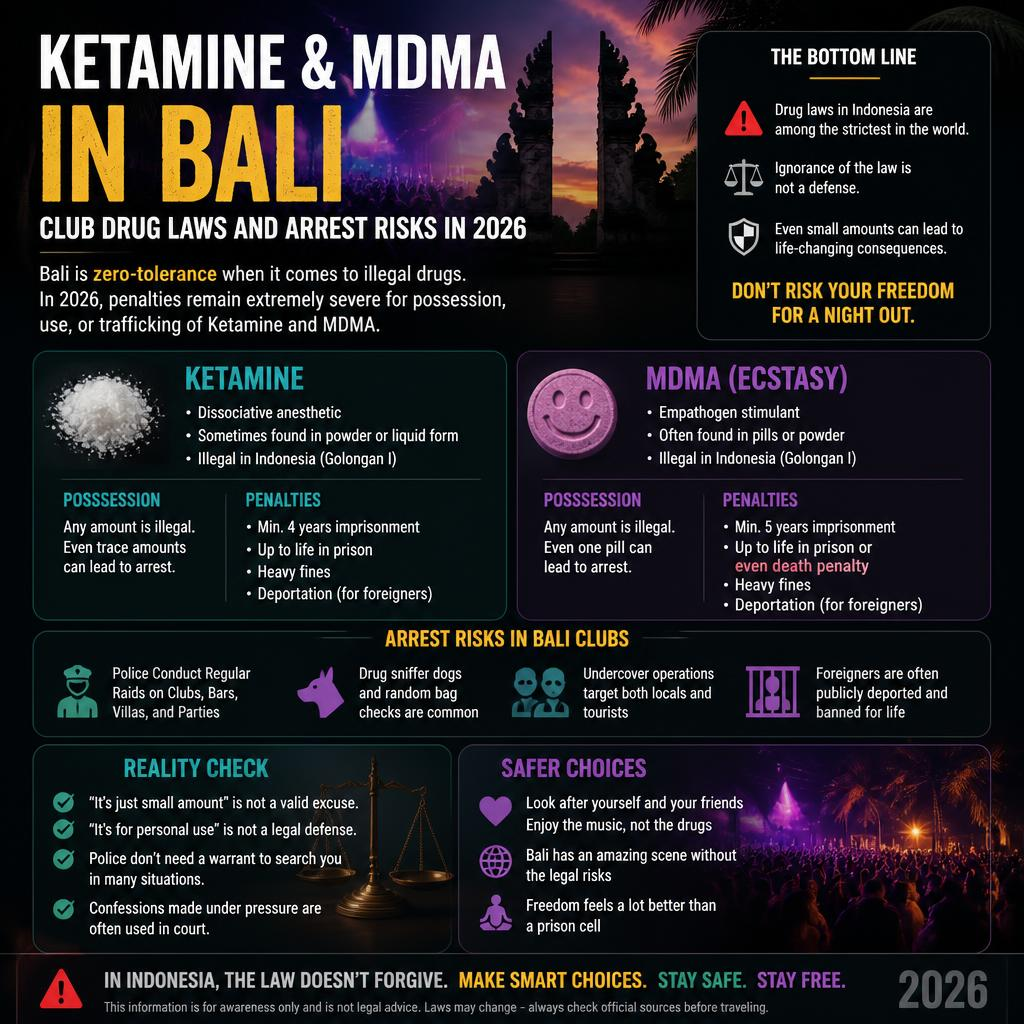
Ketamine falls under the Psychotropics Law (Law No. 5/1997) as a Golongan III psychotropic — legal only for registered medical use. Possession without prescription constitutes misuse under the Psychotropics Law and carries criminal penalties, though lighter than the equivalent Narcotics Law penalties for Golongan I substances.
Relevant Substances for Tourists in Bali’s Club Scene
| Substance | Classification | Law | Min Sentence (Possession) | Max Sentence (Trafficking) |
|---|---|---|---|---|
| MDMA (Ecstasy) | Golongan I Narcotic | Law 35/2009 | 4 years | Death penalty |
| Cocaine | Golongan I Narcotic | Law 35/2009 | 4 years | Death penalty |
| Cannabis (any form) | Golongan I Narcotic | Law 35/2009 | 4 years | Death penalty |
| Methamphetamine (Shabu) | Golongan I Narcotic | Law 35/2009 | 4 years | Death penalty |
| LSD | Golongan I Narcotic | Law 35/2009 | 4 years | Death penalty |
| Ketamine | Golongan III Psychotropic | Law 5/1997 | 2 years | 12 years |
| GHB | Golongan I Psychotropic | Law 5/1997 | 4 years | 15 years |
| MDMA + any other substance (combined charge) | Multiple | Law 35/2009 | Cumulative sentencing possible | Death penalty |
For the full context of drug laws in Bali including the death penalty, see our guide on Bali drug sentences and the death penalty. For cannabis specifically, see our guide on cannabis laws in Bali 2026.
Minimum and Maximum Sentences
Indonesian courts apply mandatory minimum sentences under Drug Law No. 35/2009. Unlike many Western criminal justice systems, Indonesian judges cannot sentence below the mandatory minimum regardless of mitigating circumstances. This is the single most important fact for tourists to understand:
- MDMA possession (Article 112, Golongan I): Minimum 4 years, maximum 12 years. No exceptions for first offenders, no suspended sentences below the minimum.
- MDMA trafficking (Article 114, Golongan I): Minimum 5 years, maximum life imprisonment or death penalty. Authorities can trigger a trafficking charge when the amount exceeds the regulatory threshold, such as 5 grams of pure MDMA, or when prosecutors argue that the quantity exceeds personal-use levels.
- Ketamine possession (Psychotropics Law): Minimum 2 years, maximum 5 years for misuse without prescription.
- Ketamine trafficking: Up to 12 years.
Courts do not systematically impose different sentences on foreign nationals and Indonesian nationals, and the law does not require them to apply different standards. Some foreign nationals have received slightly lighter sentences through diplomatic intervention; many have not. The UNODC Southeast Asia drug law enforcement report documents Indonesia’s consistently high prosecution and conviction rates.
A note on “personal use” amounts: Indonesian law does allow for a lower charge level for possession of amounts determined to be for personal use only — under Article 127 of Law 35/2009, a court can classify possession as personal use and sentence to rehabilitation rather than imprisonment. In practice, courts apply this discretion inconsistently, and foreign nationals rarely receive the same favorable treatment as Indonesian nationals. Do not plan on this provision as a safety net.
MDMA (Ecstasy) in Bali’s Club Scene
MDMA — known locally as “pil” (pill) or “ekstasi” — is present in Bali’s club scene, particularly in Kuta and Canggu. People typically offer it to tourists in clubs, often through individuals who work inside or near the venue. The offer may come from someone who appears to be a regular clubber, a person approaching informally outside the venue, or occasionally through a network connected to venue staff.
The price point advertised to tourists is typically USD 20–50 per pill. Sellers frequently adulterate substances sold as MDMA, often mixing or substituting Indonesian methamphetamine (shabu) for MDMA. This creates additional health risks because methamphetamine has a different risk profile from MDMA and can also create different legal exposure because shabu carries the same Golongan I penalties but falls under different trafficking-threshold rules.
The mechanism by which undercover police make arrests in club environments typically involves an officer posing as a fellow tourist or dealer to make a controlled purchase, then arresting the buyer. Authorities typically charge the buyer with possession and the seller with trafficking. Prosecutors usually charge foreign tourists who purchase MDMA with possession, but multiple pills can lead to trafficking charges regardless of the tourist’s intent.
Ketamine in Bali: Why Tourists Think It’s Safer
Ketamine occupies a different legal category in Indonesia than MDMA (it is a psychotropic under a separate law, not a narcotic), and this has led to a persistent belief among some tourists that it is a “safer” drug to use in Bali’s club scene. This belief is incorrect.
Ketamine is illegal without a prescription in Indonesia. Possession constitutes criminal misuse under the Psychotropics Law. The minimum sentence of 2 years for possession is lower than the MDMA minimum of 4 years — but 2 years in an Indonesian prison is not a meaningfully “safer” outcome from a practical perspective.
The specific reasons tourists misjudge ketamine risk in Bali:
- Legal status in home countries: Doctors use ketamine legally for medical treatment in most Western countries, and some jurisdictions have approved it for depression treatment. Its growing medical legitimacy at home creates a false sense of its status in Indonesia.
- Classification confusion: Some people interpret ketamine’s classification under Indonesia’s Psychotropics law rather than the Narcotics law as meaning that authorities treat it as “less illegal.” It is not — it is differently illegal, with different but still serious penalties.
- Availability: Many tourists find ketamine more readily available in Bali’s club scene than they expect, which can create a false sense of social acceptance: if many people use it, they assume authorities tolerate it. Indonesian enforcement is inconsistent, not absent.
Real Arrest Cases Involving Tourists
Drug arrests of foreign tourists in Bali are not rare occurrences. Indonesian media and consular authorities from Australia, the UK, the US, and EU member states regularly document these cases:
- Australians: Australia’s Department of Foreign Affairs and Trade (DFAT) consistently reports that Indonesian authorities arrest approximately 10–20 Australian nationals for drug offences each year, with Bali accounting for most of these arrests. Several have received sentences of 4–12 years. DFAT’s Bali travel advisory is explicit about the death penalty risk for drug trafficking.
- UK nationals: The UK’s Foreign Commonwealth and Development Office (FCDO) Bali travel advice notes that a number of British nationals are serving prison sentences in Bali for drug offences. Indonesian courts have sentenced several UK nationals to four or more years in prison for MDMA possession following arrests near clubs.
- Operation Lihai and similar club raids: Polda Bali (Bali Regional Police) has conducted multiple named narcotics operations targeting nightlife venues in Kuta and Canggu. These operations involve undercover officers and physical raids resulting in mass detentions and urine testing. Multiple foreign nationals have been arrested in each operation.
- 2023 Canggu arrests: Police arrested multiple foreign nationals in Canggu for possessing and using MDMA during targeted operations in beach clubs and bars. Cases resulted in prosecutions, not just deportations.
Drug Testing in Bali Clubs
Bali police conduct urine drug tests as part of nightlife raids and occasionally as targeted operations outside clubs. These are not the passive drug checking services available in some European countries — they are law enforcement operations in which testing positive constitutes evidence for prosecution.
Urine testing in Indonesia can detect MDMA for up to 3–4 days after use, cannabis for up to 30 days (chronic users), cocaine for up to 3 days, and methamphetamine for up to 5 days. Ketamine detection window is approximately 2–4 days.
Our dedicated guide on drug testing in Bali clubs covers the mechanics of how these operations work, including what rights tourists have during testing (limited) and what the procedure looks like from the point of detention.
The Methamphetamine Misidentification Scam
This scam is specific to the drug-purchase context in Bali and deserves explicit mention:
Sellers in Bali’s club scene frequently substitute methamphetamine (shabu) for MDMA or mix the two, so tourists who think they bought MDMA may actually receive a product containing shabu. The seller knows the difference; the buyer typically does not until symptoms make it apparent (methamphetamine produces stimulant effects substantially different from MDMA — rapid heart rate, hyperthermia, extreme alertness rather than empathogenic effects).
The legal significance: both substances are Golongan I narcotics under Indonesian law and carry identical penalties. However, methamphetamine is the Indonesian authorities’ highest enforcement priority drug — the Badan Narkotika Nasional (BNN, Indonesia’s national narcotics board) treats shabu as the country’s primary drug problem and prosecutes it aggressively. A tourist found with methamphetamine faces no lighter treatment than one found with MDMA, and may face more focused prosecution attention.
There is no safe version of this situation. The only certain protection is not purchasing or using either substance.
What Happens When You Are Arrested
If you are arrested for drug-related offences in Bali, the procedure follows Indonesian criminal process:
- Detention and confiscation: Immediate detention; all personal items including phone, wallet, and any substances confiscated. If police catch you in a club, they will take you to a police vehicle or designated staging area before transferring you to the Polda Bali narcotics unit or a local police station.
- Urine and blood testing: Testing to confirm substance presence. Positive test results are used as evidence in prosecution.
- Initial detention (up to 24 hours without charge): You have the right to consular notification immediately upon arrest. State clearly that you are a foreign national and request that your consulate be notified. Police must notify your consulate, so explicitly ask them to contact your consulate as early as possible.
- Investigation period (up to 60 days, extendable): Formal investigation by Polda Bali narcotics division. You will be questioned, typically through a translator. Do not make statements without a lawyer present — request a lawyer immediately. Your consulate can provide a list of Indonesian lawyers experienced in narcotics cases.
- Prosecution or deportation: For possession of small amounts, deportation with a permanent entry ban may be offered as an alternative to prosecution, depending on the substance, the amount, and the political context at the time. For larger amounts, prosecution is the standard outcome. Do not assume deportation is the default — it is not.
- Trial: Indonesian criminal trials can take months. Defendants are typically held in detention throughout the trial period. Kerobokan Prison in Bali (Lapas Kerobokan) is where most foreign narcotics defendants are held — its conditions have been documented in multiple international human rights reports.
The Death Penalty: Who It Applies To
For a full guide to the arrest process in Bali, see our complete guide to getting arrested in Bali. Our travel insurance guide includes a section on whether travel insurance covers legal costs — most do not cover drug-related arrests.
Indonesia’s death penalty for drug trafficking is not a historical relic or a legal technicality — it is an active policy that has been carried out against foreign nationals. The most prominent cases involve the Bali Nine (2006 arrests; two Australian nationals, Andrew Chan and Myuran Sukumaran, executed in 2015 after almost a decade on death row) and the Bali Five (multiple foreign nationals arrested for drug trafficking conspiracies).
The death penalty applies to drug trafficking under Article 114(2) of Law No. 35/2009 when the amount trafficked exceeds specified thresholds. For MDMA, the trafficking threshold that triggers potential death penalty consideration begins at 5 grams net weight of pure substance — an amount that can be contained in a small personal quantity at high purity.
The practical application involves:
- Prosecutors who determine that an amount is inconsistent with personal use can charge trafficking regardless of the defendant’s stated intent.
- Carrying a quantity that implies supply to others — multiple pills of different types, packaging materials, scales — will be charged as trafficking.
- An individual who purchased drugs in Bali for redistribution to friends — even informally, even without profit — is legally a trafficker under Indonesian law.
Amnesty International’s Indonesia report and the US State Department’s human rights report on Indonesia both document the application of the death penalty in drug trafficking cases.
For the complete legal picture of Bali’s most serious drug consequences, see our dedicated guide on Bali’s death penalty and drug sentences.