
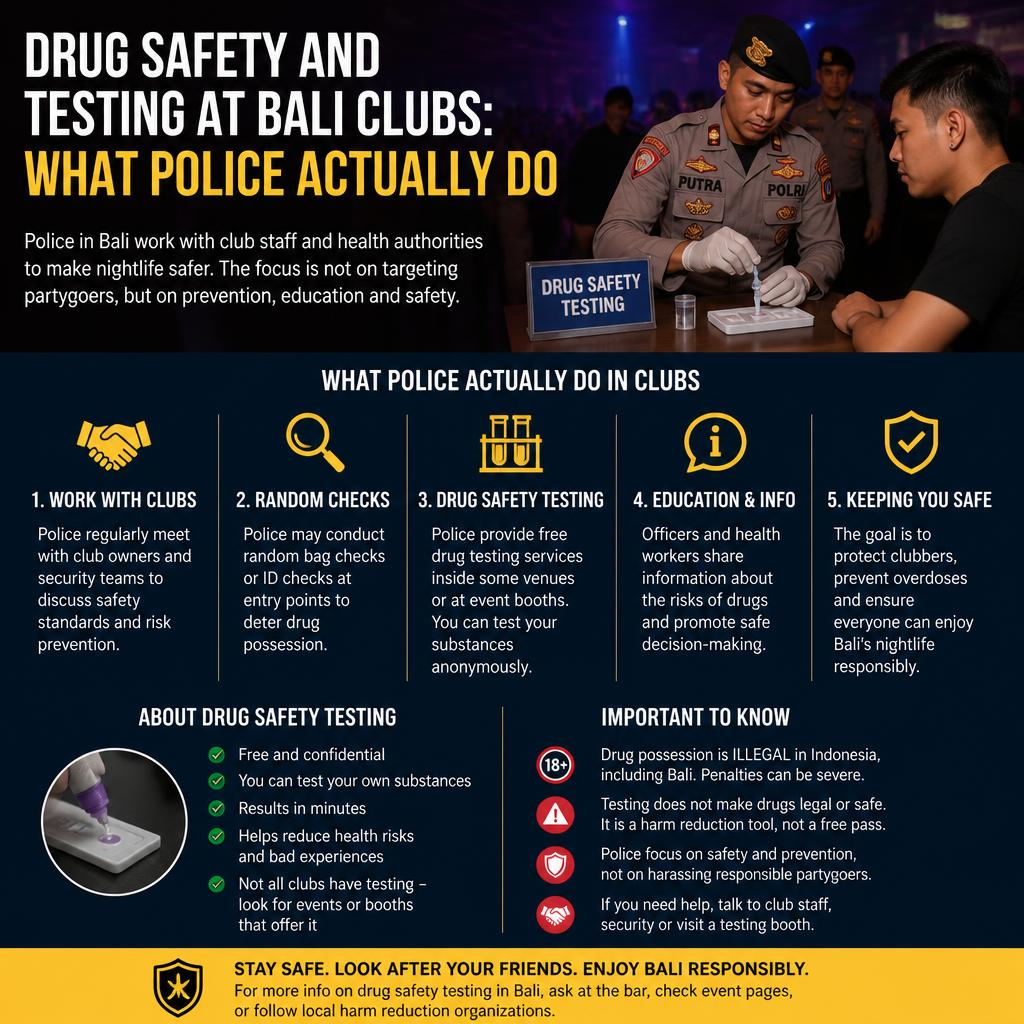
How Common Are Raids, Really?
The honest answer is: frequent enough that anyone going out in Kuta or Legian should treat the possibility as real rather than theoretical. The Badan Narkotika Nasional (BNN — Indonesia’s National Narcotics Agency) coordinates with the Polda Bali narcotics division to conduct operations at venues known or suspected to have drug activity. These are not random sweeps of peaceful bars. They target establishments where informants, prior arrests, or pattern analysis suggest regular narcotics use among patrons.
The geographic pattern is consistent. Kuta and Legian — particularly the Jalan Legian strip and surrounding side streets — see the highest raid frequency, roughly every few weeks during peak tourist season. Canggu venues, particularly those hosting large DJ events, are raided periodically — several documented operations have occurred each year since 2022. Seminyak upscale venues are targeted less often, but this reflects the operational calculation of returns on effort, not immunity. Any club in Bali is legally subject to a raid at any time.
The BNN’s annual reports consistently list Bali as a priority province for narcotics enforcement, with the BNN website publishing operational statistics showing hundreds of nightlife-adjacent arrests each year. The Polda Bali narcotics division separately publicises operations through its official channels. These are not quiet affairs — they are enforcement actions the agencies actively report publicly as deterrents.
What triggers a specific venue? Clubs known through informant networks, previous patron arrests, or visible drug dealing activity get flagged and eventually targeted. The operational cadence tends to increase around Indonesian national holidays, the Nyepi period preceding days, and when specific international events draw large crowds to Bali. Read our broader guide on Bali’s law enforcement environment in 2026 for the wider context.
How a Raid Actually Unfolds
Having spoken with people who have been inside clubs when raids happened, and drawing on press reports of documented operations, the sequence is consistent enough to describe with reasonable accuracy.
Entry and Lockdown
Police enter through multiple points simultaneously — front entrance, side exits, staff areas. Some officers wear uniforms, while others arrive in plainclothes and identify themselves when they lock down the venue. The objective in the first sixty seconds is to prevent anyone from leaving. This happens fast. Officers bring patrons who smoke outside back inside or detain them at the door when a raid begins. If officers lock down the venue while you are inside, they keep you there until the operation ends.
Officers direct bouncers and venue staff to stand aside. They typically detain and question management separately about the venue’s practices. Officers often cut the music. Lights come up. The atmosphere shift is immediate and unmistakable.
The Holding Area
All patrons are directed to a central area — typically the main dance floor or a cordoned section. Sitting on the floor or on available seating is standard. Officers circulate through the crowd. In larger operations, officers use portable barriers or rope lines to control movement. Officers tell patrons who ask to leave that they must remain until processing ends. They process Indonesian nationals and foreign visitors through the same system, although they sometimes assign translators to the foreign-patron queue.
The duration varies significantly. Smaller operations at smaller venues can process everyone in under an hour. Large-scale raids at venues with several hundred patrons — like the documented operations at Sky Garden in Kuta — have taken three to four hours. During this time, your phone remains in your possession, but filming officers or the operation is inadvisable and in some cases has led to additional detention.
Initial Screening
Officers conduct a visual and sometimes physical preliminary scan of the crowd. Officers prioritize people who appear intoxicated beyond alcohol, sweat heavily, behave erratically, or match profiles associated with known drug users. Everyone else goes through a standard queue. The queue leads to the urine test.
The Urine Test: What They Screen For
The primary screening tool used in Bali club raids is the urine rapid test kit — a multi-panel immunoassay strip that detects the presence of drug metabolites above specified threshold concentrations. These kits are standard BNN-procurement items. Officers give patrons a collection cup, direct them to a toilet area, and often stand outside to prevent tampering. They then test the sample on-site within minutes.
The panels tested in standard BNN raid kits cover:
- Methamphetamine (AMP/MET) — known locally as sabu. The most common drug found at Bali clubs and the primary focus of BNN enforcement in Bali.
- THC (cannabis/marijuana) — detectable for up to 30 days in regular users, 3–7 days in occasional users. This has implications for tourists who used cannabis before arriving in Bali.
- MDMA (ecstasy) — typically detectable for 2–4 days after use.
- Cocaine (COC) — metabolite benzoylecgonine detectable for 2–4 days.
- Opioids (OPI/MOR) — covers heroin, morphine, codeine. Detection window varies by compound.
- Benzodiazepines (BZO) — covers diazepam, alprazolam, and related compounds. Prescribed medications can trigger this panel.
False Positives: A Real Risk
Rapid immunoassay kits produce false positives at a documented rate. This is not a theoretical concern — it is a peer-reviewed pharmacological reality. Known cross-reactive substances include:
- Poppy seeds (consumed in food) can trigger opioid panels.
- Ibuprofen and naproxen have been documented as cross-reactors with the THC panel in some kit formulations.
- Certain antihistamines (diphenhydramine) can trigger methamphetamine panels.
- Pseudoephedrine-containing cold medications — common in many tourist kits — cross-react with methamphetamine panels.
- Prescribed benzodiazepines (legitimately prescribed for anxiety, sleep, or travel) will trigger the BZO panel.
If you are taking any prescription medication, carry the original packaging and prescription documentation. In practice, authorities may begin secondary processing after a false-positive result and detain you while they conduct confirmation testing. The burden then shifts to you to establish the false positive, which requires secondary laboratory analysis. This takes time you will spend at a police station.
Our guide to ADHD prescription medications in Bali covers the specific issue of legally prescribed stimulants and how to navigate Indonesian customs and enforcement.
Substances Tested and Legal Consequences
| Substance | Indonesian Classification | Urine Detection Window | Minimum Sentence (Personal Use) | Aggravated Possession / Trafficking Minimum |
|---|---|---|---|---|
| Methamphetamine (sabu) | Group I Narcotic | 3–5 days | 4 years (Art. 127) | 5–20 years (Art. 112); death penalty possible above 5g (Art. 114) |
| Cannabis / THC | Group I Narcotic | 3–30 days | 4 years (Art. 127) | 5–20 years (Art. 111); death penalty possible above 1kg (Art. 114) |
| MDMA (ecstasy) | Group I Narcotic | 2–4 days | 4 years (Art. 127) | 5–20 years (Art. 112) |
| Cocaine | Group I Narcotic | 2–4 days | 4 years (Art. 127) | 5–20 years (Art. 112); death penalty possible above 5g (Art. 114) |
| Heroin / Opioids | Group I Narcotic | 1–3 days (varies) | 4 years (Art. 127) | 5–20 years (Art. 112); death penalty possible above 1g (Art. 114) |
| Benzodiazepines (unprescribed) | Group III Psychotropic (Law 5/1997) | 2–7 days | Up to 5 years (varies by article) | Up to 15 years for distribution |
| Kratom | Legal (removed from controlled list 2022) | N/A | None | None |
| Kava | Legal | N/A | None | None |
| Alcohol | Legal (regulated) | N/A | None | None |
Sentences under Law No. 35/2009 on Narcotics. Article 127 governs personal use; Articles 111–114 govern possession and trafficking. See our detailed guide to Bali’s drug sentences and death penalty for full threshold quantities.
What Happens After a Positive Result
A positive rapid test result does not immediately result in handcuffs and departure. The process has stages, each of which matters.
Secondary Confirmation
Officers note the positive result and move you to a separate area from the general patron pool. At this stage, officers may collect a second urine sample for laboratory confirmation or transport you to a police facility for blood testing. The rapid kit result establishes probable cause for detention. The laboratory test is what the formal charge is built on.
Police Station Processing
Police transport you to the nearest station—typically Polres Kuta for raids in Kuta or Legian, or the relevant area command elsewhere. At the station, officers book you, inventory your belongings, and place you in a holding cell while they await the laboratory result. This process typically takes 12–24 hours for the confirmation result to return.
This is the point at which you should request — firmly and repeatedly — to contact your embassy. Under Vienna Convention on Consular Relations obligations (which Indonesia has ratified), you have the right to have your consulate notified. Officers are legally required to facilitate this. In practice, there is sometimes delay; persistence matters.
Formal Charge Under Law No. 35/2009
If the laboratory confirmation is positive, you will be formally charged. The most common charge for a tourist with no drugs found on their person at the club is Article 127 — using narcotics without authorisation, which carries a minimum 4-year sentence for Group I narcotics (methamphetamine, cannabis, MDMA, cocaine).
Article 127 also allows a judge to order rehabilitation instead of imprisonment if the court determines that the defendant has a drug addiction and that rehabilitation serves the public interest. This is Article 54 — the rehabilitation pathway. It is not automatic, not guaranteed, and not within the defendant’s power to trigger unilaterally. It requires a medical assessment, prosecution consent or judicial overrule, and a place in an accredited BNN rehabilitation facility. For a first-time foreign tourist with no prior Indonesian narcotics record, the pathway exists in law. Whether it applies depends on the specific facts, the prosecutor’s posture, and — frankly — the specific court.
Even tourists who use cannabis only for personal use and face charges solely under Article 127 can spend months in detention while awaiting trial and receive a formal criminal conviction. The idea that being “just a tourist” or “just a user” produces a warning and a flight home is not supported by case history. See our detailed legal breakdown at Getting Arrested in Bali: What Actually Happens.
Your Legal Rights During a Raid
Indonesian law provides a set of procedural rights that apply to all persons detained, regardless of nationality. Knowing them before you need them matters.
Right to Remain Silent
You are not required to answer questions beyond providing basic identification. Under Indonesian criminal procedure (KUHAP), a suspect has the right not to incriminate themselves. In practice, police will ask questions and may persist. You can state, calmly and clearly, that you wish to speak to a lawyer and your embassy before answering questions. This is not obstruction. It is a legal right.
Right to a Lawyer
You have the right to legal representation from the point of detention. If you do not have a lawyer, the police are required to facilitate one. This does not mean a lawyer will appear quickly. It means the right exists in law and you should assert it. Having the contact number of an English-speaking Indonesian lawyer before you go out in Bali is practical preparation, not paranoia.
Right to an Interpreter
All formal proceedings—including questioning, charging, and court appearances—must use a language you understand, with a certified interpreter provided when necessary. Assert this right if authorities question you in Indonesian without translation.
Right to Contact Your Embassy
This is the right that most tourists underestimate. Your consulate cannot get you out of a criminal process, but their notification and presence matters for a range of reasons: ensuring humane treatment, facilitating lawyer access, communicating with your family, and — in serious cases — making formal representations. State your nationality clearly and request embassy notification immediately and repeatedly.
What You Should Not Do
- Do not run. Attempting to flee adds obstruction charges and, practically, there is nowhere to go — exits are secured.
- Do not argue with officers during the raid. The venue is not a place to litigate your rights. Comply with the lockdown process; assert your legal rights formally once at the station.
- Do not offer money. The situation and risks involved in attempting bribery are covered in the next section. The short version: it can make everything significantly worse.
- Do not flush, swallow, or dispose of anything. Officers observe the urine collection process precisely because of attempts to adulterate samples. Observed disposal of substances is an aggravating factor.
The Bribery Trap
Bribery of Indonesian police officers (suap) is a criminal offence under Law No. 31/1999 on Corruption. This matters because the tourist who offers money in a panic is not simply engaging in a grey-area local custom — they are committing an additional crime on top of whatever the drug test has already found.
A documented pattern shows what happens next when someone attempts to bribe officials at the club stage. Some officers decline and the attempt itself becomes an additional aggravating fact in the case file. Some officers accept money and then proceed with the arrest anyway, leaving the tourist in a worse position: both positively tested and on record as having attempted to bribe an officer. In a small number of documented cases, the bribery offer led to escalation — the officer involved reported the attempt, which drew more serious attention from supervisors and prosecutors to the case.
Press reporting from Indonesia Expat and Bali Discovery has covered cases where tourists paid amounts ranging from IDR 5 million to IDR 50 million (roughly USD 300 to USD 3,000) at the club stage — and were still arrested and charged. The money disappeared, but the situation remained the same or became worse.
Our guide on Police Extortion in Bali covers the broader context of corrupt encounters with Bali police, including rogue oknum officers who shake down tourists during traffic stops, a separate and lower-stakes situation. The traffic stop situation involves an informal, deniable encounter where the corrupt officer has strong incentive to keep it quiet. A drug raid is a multi-officer, formally logged, BNN-coordinated operation. The risk calculus is entirely different. Do not treat these situations as equivalent.
Real Documented Cases at Bali Clubs
The following cases come from reports by Reuters, the BBC, Bali Discovery, and Indonesian national media. I have omitted all individuals’ names.
Sky Garden, Kuta — Recurring Operations
Sky Garden on Jalan Legian is one of Bali’s largest and longest-running club venues, operating across multiple floors. It has been the subject of multiple documented BNN-coordinated drug operations. In a 2023 operation reported by Bali Discovery, police detained approximately 200 patrons, conducted urine testing across the group, and arrested 12 individuals — including several foreign nationals — on narcotic use charges. The venue remained open after the operation, consistent with Indonesian enforcement practice: raids target users, not routinely the venue licence.
Mirror Club, Seminyak — 2022 Operation
Mirror Club, a high-end Seminyak venue, was subject to a narcotics operation in 2022 that attracted attention partly because of the venue’s upscale positioning. The operation showed that authorities target more than budget tourist-strip venues. Police arrested three foreign nationals after they tested positive for drugs in urine tests. Court records published by Indonesian media confirmed that prosecutors charged all three under Article 127 of Law No. 35/2009. Two received suspended sentences after they established their first-offender status and completed the rehabilitation pathway, while the third received a custodial sentence after the proceedings disclosed a prior narcotics record in their home country.
Legian Strip — Australian Tourists, Multiple Documented Incidents
The Australian Department of Foreign Affairs and Trade (DFAT) publishes general statistics on consular cases. Bali consistently accounts for the highest volume of Australian drug-related consular cases of any overseas location, with drug arrests at or near nightlife venues being the most common category. Reporting by the ABC in 2024 detailed a series of arrests of Australian tourists at Legian strip clubs over a three-month period, with six individuals charged under narcotics laws. All six faced minimum four-year sentences. Authorities admitted one of them to a rehabilitation program under Article 54 after holding them in pre-trial detention for eight months.
Canggu DJ Event — 2024 Operation
A joint BNN and Polda Bali team raided a large-scale DJ event at an open-air Canggu venue in 2024 while the event was underway. Reuters reported the operation, and Indonesian national television also covered it. Authorities detained approximately 300 patrons. Testing identified 22 positive results. Of these, nine were foreign nationals from five countries. The event highlighted that the enforcement net extends well beyond the Kuta-Legian strip and applies to the Canggu scene that has grown substantially since 2019.
What Is Not Tested: Legal Substances in Bali
Clarity matters here. The drug raids and urine testing described in this article apply to controlled narcotics under Indonesian law. Several substances that have legal grey areas in other countries are clearly legal in Indonesia.
Alcohol is legal in Bali for adults. Presidential Regulation No. 74/2013 regulates alcohol, which licensed venues can legally sell. BNN urine test kits used during club raids do not detect alcohol, so officers do not charge patrons with narcotics offences simply because they are drunk. Visible intoxication may attract officers’ attention during a raid, but alcohol itself does not constitute a narcotics offence. For the complete picture of alcohol law, see our Bali Alcohol Laws Guide.
Kratom (Mitragyna speciosa) was removed from Indonesia’s controlled substances list in 2022 after years of deliberation. It is now legal to possess and consume in Indonesia, though its legal status for export remains complex. It is not included in BNN urine test panels used in club raids.
Kava (Piper methysticum) is legal in Indonesia and not a scheduled substance. It is not screened in standard narcotics test panels.
Note on magic mushrooms (psilocybin): psilocybin is a Group I Narcotic under Indonesian law. Standard urine test panels used in club raids do not screen for it because the body clears it quickly, and standard immunoassay strips do not detect its metabolites. This does not make it safe or legal — possession carries the same consequences as other Group I substances. The absence from urine screening is a pharmacological fact, not a loophole. Read our full analysis at Magic Mushrooms in Bali: The Legal Reality.
Before You Go Out: Practical Checklist
Do Not Carry Anything
The most straightforward protection is leaving the hotel with nothing that could create a problem. This means not carrying any narcotic substances, obviously — but it also means not carrying unmarked prescription medications, not carrying someone else’s bag or jacket, and not accepting packages from anyone at a venue. The “hold this for me” request is a documented way that people end up holding substances that are not theirs during a raid.
The Drink Spiking Risk
Drink spiking is a documented problem at Bali clubs independent of any raid consideration. Substances including benzodiazepines (commonly used in drink spiking for their sedative effect) can trigger the BZO panel on a urine test. A spiked drink can therefore produce a positive test result that you did not cause and cannot fully explain in the moment. The practical precaution: do not accept drinks from people you do not know, do not leave your drink unattended, and avoid accepting pre-poured drinks. Our companion guide on drink spiking in Bali covers this risk in detail.
The THC Detection Window Problem
Cannabis is legal in a growing number of countries and territories. Tourists from the Netherlands, Canada, several US states, and other jurisdictions sometimes consume cannabis legally at home before travel, not considering that THC metabolites remain detectable in urine for up to 30 days in regular users. A tourist who last used cannabis two weeks ago in a legal jurisdiction can test positive on a BNN urine kit in a Bali club raid. There is no legal defence that addresses this: the metabolite is present, the substance is a Group I Narcotic in Indonesia, and the test does not distinguish between use in Indonesia and use abroad. If you use cannabis regularly and are travelling to Bali, the detection window needs to factor into your planning.
For a full analysis of cannabis law in Indonesia, see Is Weed Legal in Bali in 2026?
Emergency Contacts to Have Before You Go Out
- Your country’s consulate or embassy in Bali or Jakarta — save the 24-hour emergency line, not just the general enquiries number. Most embassies have a separate after-hours duty officer line for citizens in distress.
- A local English-speaking lawyer’s number — the Bali bar association (PERADI Bali) can provide referrals. International legal firms with Bali offices are an option for those who want to prepare in advance.
- Your accommodation’s contact details — so that someone can be informed of your situation.
- Bali Police Emergency: 110
- BNN Hotline: 0800-111-8181 (this is a reporting line, but also the point of contact if you believe you are being improperly treated during a raid)
Our full guide to getting arrested in Bali contains a comprehensive emergency contacts list and covers the full legal process step by step.