
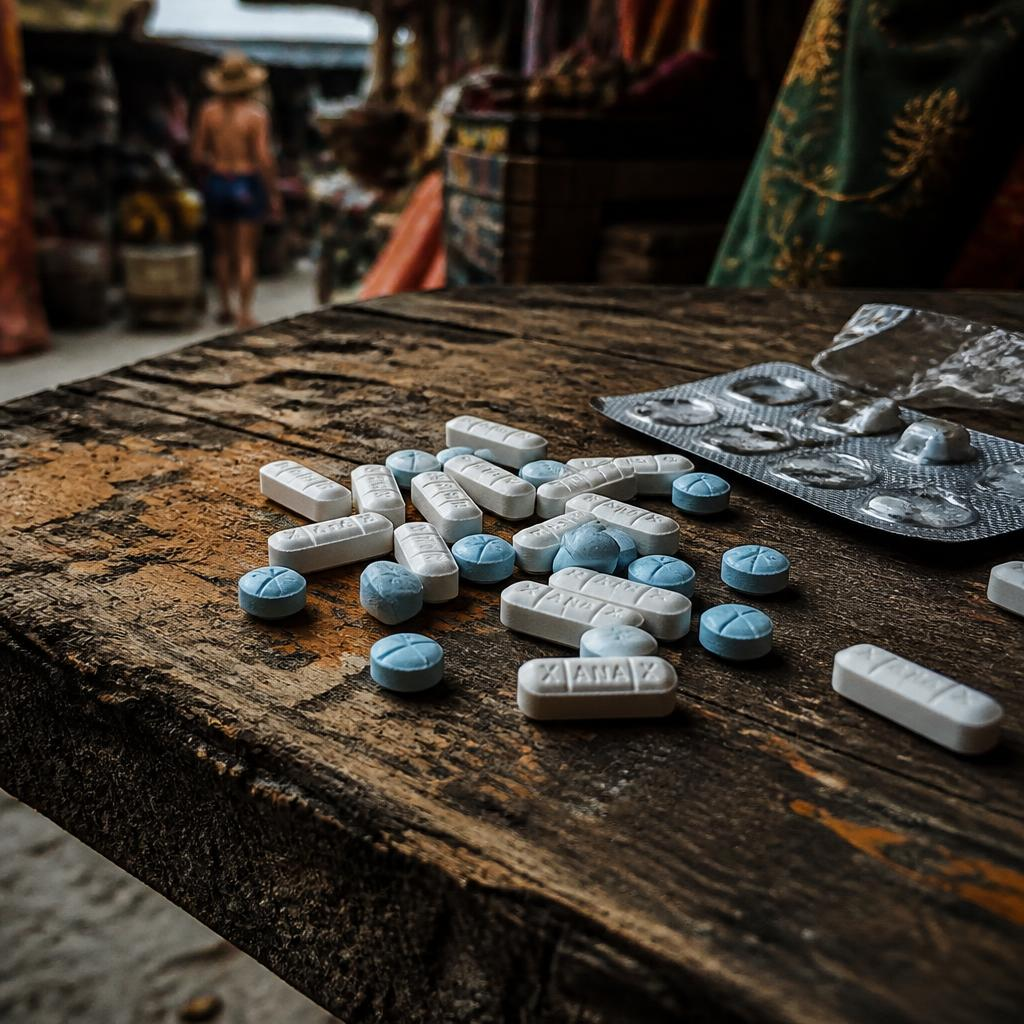
The Reality: Available at Some Pharmacies, Illegal to Buy Without a Prescription
Walk into the right pharmacy in Kuta, Seminyak, or Legian, ask confidently for “diazepam 5mg” or even “Valium,” and there is a reasonable chance a box will appear from behind the counter without anyone asking you for a prescription. This has been the case for years. Backpacker forums reference it. Long-term expats know which pharmacies are more relaxed. Some tourists treat benzodiazepines as a feature of Bali — a place where you can manage your anxiety or sleep problems without the administrative overhead of seeing a doctor.
This article is not going to pretend that the over-the-counter benzodiazepine market in Bali does not exist. It does. But what most tourists fundamentally misunderstand is the legal status of what they are participating in when they buy Xanax or Valium without a prescription in Bali. This is not a local custom that differs from Western norms. It is not a grey area in Indonesian pharmaceutical regulation. It does not work like buying ibuprofen without a prescription in a country where pharmacies sell it over the counter. Purchasing benzodiazepines without a prescription in Indonesia is a criminal offence — and it is one where the pharmacy’s willingness to sell is not a legal defence, a mitigating factor, or even useful context if you are caught.
The casual availability at some pharmacies reflects the pharmacy breaking Indonesian law, not Indonesian law permitting the transaction. Understanding that distinction is essential before you make any decisions about benzodiazepines during your Bali trip.
Indonesian Drug Law: Where Benzodiazepines Actually Sit
Indonesia regulates controlled substances through two primary legislative frameworks that operate in parallel. Tourists often hear about Law No. 35/2009 on Narcotics (Undang-Undang Nomor 35 Tahun 2009 tentang Narkotika) because it governs the substances with the most dramatic penalties — heroin, cocaine, methamphetamine, MDMA, cannabis — and because the death penalty provisions under that law generate international news. For a full breakdown of what that law entails and the sentences it carries, see our guide to Bali’s drug sentences including the death penalty.
Indonesian authorities primarily regulate benzodiazepines under a different and older law: Law No. 5/1997 on Psychotropics (Undang-Undang Nomor 5 Tahun 1997 tentang Psikotropika).This law classifies psychotropic substances into four groups (Golongan I through Golongan IV), with Group I facing the strictest controls and Group IV facing the least. However, Indonesian law still requires a valid prescription for lawful possession of Group IV substances.
Indonesian Drug Law: Where Benzodiazepines Actually Sit
Benzodiazepines sit in Group IV (Golongan IV) under UU 5/1997. This classification means they have accepted medical uses in Indonesia and are available through the legitimate pharmaceutical system — but only through the legitimate pharmaceutical system, meaning with a valid prescription from a licensed Indonesian doctor or equivalent documentation when imported from abroad.
The oversight body for pharmaceutical regulation in Indonesia is Badan Pengawas Obat dan Makanan (BPOM) — the National Agency of Drug and Food Control. BPOM maintains the official list of scheduled psychotropic substances, regulates their import, and sets the documentation required for lawful possession. Their regulations are binding on pharmacies and on anyone bringing controlled psychotropics into Indonesian territory.
It is worth being clear about how UU 5/1997 and UU 35/2009 relate. They are separate laws with separate penalty scales and separate classification systems. The psychotropics law is not the narcotics law. Benzodiazepines are not classified as narcotics under the 2009 law. This distinction matters because UU 5/1997 carries serious penalties, while UU 35/2009 imposes far more severe fines. But “less severe than a potential death sentence” does not mean “not serious.” Up to five years imprisonment is not a trivial outcome for a tourist who bought a box of diazepam without a prescription.
Benzodiazepine Classification Under Indonesian Law
| Generic Name | Brand Name(s) | Indonesian Classification | Governing Law | Available in Indonesia by Prescription? |
|---|---|---|---|---|
| Alprazolam | Xanax, Alganax | Golongan IV Psikotropika | UU No. 5/1997 | Yes — prescription required |
| Diazepam | Valium, Stesolid, Valisanbe | Golongan IV Psikotropika | UU No. 5/1997 | Yes — prescription required |
| Lorazepam | Ativan, Merlopam | Golongan IV Psikotropika | UU No. 5/1997 | Yes — prescription required |
| Clonazepam | Klonopin, Riklona | Golongan IV Psikotropika | UU No. 5/1997 | Yes — prescription required |
| Nitrazepam | Mogadon, Dumolid | Golongan IV Psikotropika | UU No. 5/1997 | Yes — prescription required |
| Clobazam | Frisium | Golongan IV Psikotropika | UU No. 5/1997 | Yes — prescription required |
| Zolpidem | Ambien, Stilnox | Golongan IV Psikotropika | UU No. 5/1997 | Yes — prescription required |
| Midazolam | Dormicum | Golongan IV Psikotropika | UU No. 5/1997 | Yes — hospital/clinical use only |
Note: Zolpidem (Ambien/Stilnox) is classified as a Group IV Psychotropic in Indonesia despite being technically a Z-drug rather than a benzodiazepine. Its regulatory treatment is identical. Midazolam is primarily used in clinical anesthesia settings, and retail pharmacies do not sell it.
What the Penalties Look Like for Tourists
The penalty provisions of UU 5/1997 that are most relevant to tourists break down along a few distinct scenarios:
Possession Without a Valid Prescription
Article 62 of Law No. 5/1997 is the core provision applying to individual possession. Anyone who unlawfully possesses or carries psychotropic substances may face up to 5 years in prison and a maximum fine of IDR 100 million (approximately USD 6,200). This applies to possession of Group IV psychotropics including all benzodiazepines.
“Without right” in practice means: without a valid prescription from a licensed Indonesian doctor, or without the documentation required for lawful import if the substance was brought from abroad. The quantity possessed can affect how severely authorities prosecute the offence, but it does not determine whether the offence exists. One strip of alprazolam tablets purchased without a prescription is technically as illegal as a full month’s supply.
Bringing Benzos from Abroad Without Declaration
If you bring benzodiazepines from home and do not declare them at customs, you face two separate legal exposures simultaneously:
- A customs violation under Law No. 17/2006 on Customs (Undang-Undang Kepabeanan), which prohibits the undeclared importation of controlled substances, and
- A psychotropics possession offence under Article 62 of UU 5/1997, because undeclared importation means you do not have lawful import documentation and therefore do not have lawful possession.
These are not alternative charges — prosecutors can and do pursue both simultaneously. For the full picture of what Indonesian customs procedures look like when things go wrong, see our complete guide to Bali customs rules for tourists.
Purchasing From a Pharmacy Without a Prescription
This is the scenario that catches people off guard. You walk into a pharmacy, buy diazepam, and walk out with a box of tablets with a pharmacy label on it. In your mental model, having a labelled product from a pharmacy makes the possession legitimate. In Indonesian law, it does not. The pharmacy label is evidence of where you bought the substance. It is not evidence that you had a prescription or that your possession is lawful. The pharmacist who sold it to you may face criminal or regulatory consequences for the sale — but that is an entirely separate matter and has no bearing on your personal legal exposure.
This is not theoretical. In Bali, authorities have arrested tourists for possessing prescription medications bought from pharmacies, and courts have rejected the defence that “the pharmacist sold it to me.” Indonesian law places the responsibility for lawful possession on the possessor, not on the person who made the sale.
Real Cases Involving Tourists
English-language media do not always document tourist arrests involving benzodiazepines in Bali in detail, partly because these cases often involve lesser charges and receive less international attention than narcotics cases. However, several documented patterns are worth knowing:
Tourists have faced detention at Ngurah Rai Airport during both arrival and departure screening after authorities found benzodiazepines removed from their original packaging and stored in pill organizers or small bags. When tourists could not produce a prescription, authorities confiscated the tablets and detained them for questioning. Outcomes have ranged from confiscation with a warning (rare, and dependent on the specific officer and circumstance) to formal charging. The risk is highest in the departure context, which is discussed in detail below.
More commonly, benzo possession becomes apparent during police encounters for unrelated reasons — a scooter accident, a noise complaint, a brawl at a bar. If police find unlabelled or unprescribed medications during a search, the possession charge compounds whatever the original situation involved. See our guide to getting arrested in Bali for how Indonesian police and prosecution procedures work in practice.
The Pharmacy Reality: What Actually Happens at the Counter
Bali has hundreds of pharmacies — apotek — ranging from the major national chains like Guardian, K24, and Kimia Farma to small independent neighbourhood shops. The regulatory compliance environment varies significantly between these establishments.
The major chains — Guardian, K24, and Kimia Farma in particular — generally comply with prescription requirements for controlled psychotropics. A pharmacist at a K24 in Denpasar is unlikely to sell you alprazolam or diazepam without a valid Indonesian prescription. They face too much regulatory risk to sell controlled substances, and staff typically receive training on the legal requirements.
Smaller independent pharmacies — particularly those in tourist-heavy areas like the Kuta strip, Legian, and parts of Seminyak — operate differently in practice. Some do sell diazepam or lorazepam with minimal or no questions asked. The products they sell are legitimate pharmaceutical-grade medications with proper BPOM registration — the substances themselves are not counterfeit. The transaction is simply illegal because no prescription was involved.
From a tourist’s perspective, the key points are:
- The fact that a pharmacy sold you the medication without a prescription does not make your possession legal. The pharmacy took a risk with its licence. You took a risk with your freedom.
- The friendly transaction at the counter does not create any paper trail that protects you. There is no receipt that says “sold with pharmacist’s professional endorsement in lieu of prescription.” You have a box of tablets and no documentation explaining why your possession is lawful.
- The pharmacist’s professional licence and the pharmacy’s operating permit are separate from your personal legal situation. Even if the pharmacy faced consequences for the illegal sale, those consequences would not reduce or eliminate your own legal exposure.
If you are already in Bali and bought benzodiazepines without a prescription, see a local doctor and ask whether they can legally prescribe the medication based on your medical needs. If the doctor provides a prescription, carry the documentation with you going forward. This is not a guarantee, but it is significantly better than carrying the substance with no documentation at all.
Bringing Your Own Benzos to Bali Legally
If you take benzodiazepines regularly — for anxiety, panic disorder, sleep, or any other condition — and you want to bring your medication to Bali lawfully, the process is straightforward but requires preparation before you travel. Do not leave this to the last minute.
Step 1: Original Packaging, Intact
Your medication must travel in its original commercially labelled packaging. The pharmacy label showing your name, the medication name and dosage, the prescribing doctor’s name, and the pharmacy’s details must be intact and legible. Do not consolidate medications into pill organisers, zip-lock bags, or any container other than the original pharmacy packaging. Tablets without their original labels are anonymous, so customs officers cannot readily determine what they contain or whether you lawfully possess them without laboratory testing. You do not want to trigger that process in the arrivals hall.
Step 2: Doctor’s Letter
You need a letter from your prescribing physician, prepared before you travel, that covers:
- Your full name and date of birth as they appear in your passport
- Your diagnosis or condition being treated
- The medication name (generic and brand), dosage, and frequency
- The total quantity being carried and the number of days’ supply this represents
- A statement that the medication is medically necessary and that interrupting treatment poses a health risk
- The doctor’s name, licence number, clinic address, and signature
A standard prescription printout is not sufficient on its own. The letter should use the clinic’s letterhead and clearly explain the medical information so Indonesian customs officials can understand it even if they do not read English fluently.
Step 3: Bahasa Indonesia Translation
Having your prescription and doctor’s letter translated into Bahasa Indonesia by a certified translator (penerjemah tersumpah) significantly strengthens your position at customs. It demonstrates preparation and good faith, and it makes the documentation immediately legible to the Indonesian customs officers reviewing it. Your country’s Indonesian embassy or consulate can provide a list of certified translators.
Step 4: Declare at Customs
On your arrival customs declaration form, declare your controlled medications. Select the red channel (declarations channel) rather than the green channel. Present your documentation proactively when you reach the customs officer. This is the single most important step. Failing to declare controlled psychotropics can turn a routine documentation check into a criminal matter if authorities find them.
Step 5: Quantity Limits
The general guidance from BPOM for personal import of controlled medications is a maximum of 30 days’ supply for personal use without requiring a formal import permit. If you are staying in Bali for longer than 30 days and require a larger quantity, contact BPOM directly before travel to determine whether a formal import authorisation is required. For standard holiday trips of one to three weeks, a 30-day supply with proper documentation should be manageable at customs.
Carry Documentation Throughout Your Stay
Customs clearance on arrival is not the end of the documentation requirement. If police stop you anywhere in Bali and find benzodiazepines in your bag, hotel room, or elsewhere, you need to produce your prescription documentation immediately. Keep a copy accessible at all times. Keep the original packaging intact throughout your stay. Prescribed ADHD medications have the same documentation requirements; for a parallel discussion, see our guide to travelling with prescription ADHD medication to Bali.
What Happens at Customs When They Find Benzos
Ngurah Rai International Airport’s customs operation uses a combination of X-ray screening, narcotics detection dogs, and targeted physical inspection. The narcotics dogs at DPS are trained primarily for the substances most commonly smuggled — cannabis, heroin, cocaine, methamphetamine — rather than for pharmaceuticals specifically. However, X-ray irregularities, passenger profiling, or random selection can prompt officers to conduct a physical inspection and identify the medication.
The detection scenario that most commonly applies to benzodiazepines is not a dog alert but a physical search: a customs officer opens your bag, finds tablets in an unlabelled container or a medication that looks unfamiliar, and asks what it is. At that point, your response and your documentation determine everything.
If You Have Documentation and Have Declared
The officer reviews your documentation, confirms the quantity matches your prescription, and processes you through. This can take additional time — expect 20 to 40 minutes beyond normal processing — but it is not a legal crisis. The red channel exists precisely for this purpose. Customs officers who deal with declared controlled medications every day understand the difference between a tourist with a legitimate prescription and a trafficking situation.
If You Have Not Declared
If authorities find controlled medication after you pass through the green channel without declaring it, they may treat the case as an undeclared importation, even if you have supporting documentation. The failure to declare is itself an aggravating factor. Even if you subsequently produce documentation, the undeclared importation is already on the record. The customs officer’s discretion about whether to process this as a documentation oversight or a criminal matter shifts materially once you have passed through the green channel.
If You Have No Documentation
This is the worst-case scenario. Controlled psychotropics found without documentation and without declaration are treated as unlawfully imported controlled substances. The process moves from customs to narcotics police (Sat Narkoba). Your medications are confiscated as evidence. You are detained for questioning. A police report is filed. Your consulate is notified. The outcome from this point depends on the quantity involved, your cooperation, and the specific officers and prosecutors involved — but none of the realistic outcomes are good.
The World Health Organization’s guidance on controlled substance transport for personal medical use is consistent with Indonesian expectations: carry the original prescription, declare at customs, carry only a medically justified quantity. These are not extraordinary requirements. They are standard international travel practice for controlled medications.
The Departure Risk: Taking Locally-Purchased Benzos Home
A scenario that tourists consistently underestimate: buying benzodiazepines in Bali over the counter — whether from a pharmacy or from another source — and then attempting to take them home when you depart.
The departure process at Ngurah Rai involves security screening of all carry-on bags and, for flights to high-scrutiny destinations (Australia, the UK, the USA, Japan), additional departure screening by the Indonesian Narcotics Board (BNN) and customs. This screening is specifically designed to catch substances being exported from Indonesia, including locally purchased controlled substances.
The legal exposure at departure operates on two levels:
Indonesian Export Law
Exporting psychotropic substances from Indonesia without authorisation is an offence under UU 5/1997. Even if you purchased the diazepam from an Indonesian pharmacy — even if you somehow have a pharmacy label — exporting it without a valid prescription and export documentation is a controlled substance export offence. This carries similar penalties to the possession offence: up to 5 years, with aggravated provisions for larger quantities.
Your Destination Country’s Import Law
When you land at home carrying Indonesian-labelled diazepam without documentation from your home country’s prescribing doctor, your destination customs now sees undeclared psychotropics in your luggage. In Australia, the UK, the USA, and most EU countries, this triggers their own controlled substance import procedures. The Indonesian pharmacy label is not documentation that satisfies Australian Therapeutic Goods Administration requirements or UK Home Office requirements or US DEA import procedures. You may face action in both countries for the same tablets.
The practical lesson: benzodiazepines purchased in Bali without a prescription should not travel internationally in either direction. If you find yourself in a situation where you have purchased them and are wondering what to do before your departure, the cleanest option is to not take them through the airport.
Alternatives Available in Bali Without Restriction
If anxiety, sleep difficulty, or stress is the underlying issue you are trying to manage, Bali has a range of options that do not involve controlled substances or any legal risk.
Antihistamines for Sleep
First-generation antihistamines — diphenhydramine (the active ingredient in Benadryl, Nytol, and many OTC sleep aids) and doxylamine (Unisom in the USA) — are available in Bali pharmacies without a prescription. They cause significant drowsiness and are effective for occasional sleep difficulty. They are not appropriate for regular use and are not a substitute for prescription sleep medication for chronic insomnia, but for a holiday sleep disruption caused by jet lag or an uncomfortable environment, they are a legitimate and legal option. Local brands of diphenhydramine-containing products are inexpensive and widely available.
Melatonin
Melatonin supplements are available at larger pharmacies and health supplement stores in Bali without restriction. For jet lag specifically — which is one of the most common reasons tourists want sleep medication in Bali — melatonin is evidence-supported and appropriate. The WHO recognises sleep regulation as a meaningful component of overall mental health, and melatonin’s role in circadian rhythm management is well-established. Standard doses of 0.5 to 5mg taken 30 minutes before the local bedtime are the typical recommendation for jet lag management.
Herbal and Traditional Supplements
Indonesia has a rich tradition of herbal medicine (jamu), and several preparations with mild calming effects are available throughout Bali. Products containing valerian root, passionflower, chamomile extract, and various traditional Indonesian botanical preparations are sold at pharmacies and health stores. These are not regulated as controlled substances and can be purchased and transported freely. Their efficacy is generally less potent than pharmaceutical anxiolytics, but for mild situational anxiety, they are worth considering.
Non-Pharmaceutical Approaches
Bali’s wellness infrastructure is extensive. If the reason you are considering benzodiazepines relates to anxiety or stress management, the island offers world-class yoga centres (particularly in Ubud and Canggu), sound healing and meditation facilities, spa treatments, and breathwork practitioners. For situational holiday stress, these are appropriate tools. Genuine clinical anxiety disorders requiring pharmacological management, they are supplementary — not replacements — but they can reduce the intensity of symptoms meaningfully.
For stomach-related anxiety triggers, which are common in Bali due to changes in diet and intestinal adjustment, see our guide to treating Bali belly for specific OTC medications available locally without restriction.
Getting a Legitimate Prescription in Bali
If you have an established need for benzodiazepines and either run out during your trip, did not bring enough, or did not know you would need them before travelling, the legitimate pathway is to see a doctor in Bali and obtain an Indonesian prescription.
Finding a Doctor in Bali
Bali has a functioning medical infrastructure with international-standard clinics in the main tourist areas. The BIMC Hospital network (Kuta and Nusa Dua), Kasih Ibu Hospital in Denpasar, and SOS Medical Clinic in Seminyak all have English-speaking doctors and are familiar with treating international patients. International SOS and Global Doctor operate clinics specifically aimed at expatriates and tourists.
What to Expect from a Consultation
An Indonesian doctor will conduct a clinical assessment. They are not going to simply prescribe benzodiazepines on request because a tourist says they take them at home. They will ask about your medical history, your existing diagnosis, your previous prescriptions, and your specific situation. If you have documentation of your home prescription — even if it is not sufficient for customs purposes — bring it to the appointment as supporting clinical information.
An Indonesian doctor who determines that a benzodiazepine prescription is clinically appropriate will write you a valid Indonesian prescription. This prescription, combined with a properly labelled Indonesian pharmacy dispensing the medication, creates a lawful possession situation. Keep the prescription and the pharmacy label together. This documentation will also be necessary if you are stopped by police at any point during your remaining stay.
Cost Considerations
A consultation at an international clinic in Bali typically costs between USD 50 and USD 150, depending on the facility and the complexity of the assessment. The medication itself — diazepam, for example — is inexpensive at Indonesian prices if dispensed through the legitimate pharmacy system. Travel insurance that covers medical consultations will typically cover a clinic visit for this purpose; check your policy before assuming it will not be covered.
The Indonesia Ministry of Health’s official health portal (kemkes.go.id) provides information on the Indonesian healthcare system and registered medical facilities. International clinics operating in Bali are licensed by the relevant provincial health authority and operate within the Indonesian regulatory framework.