
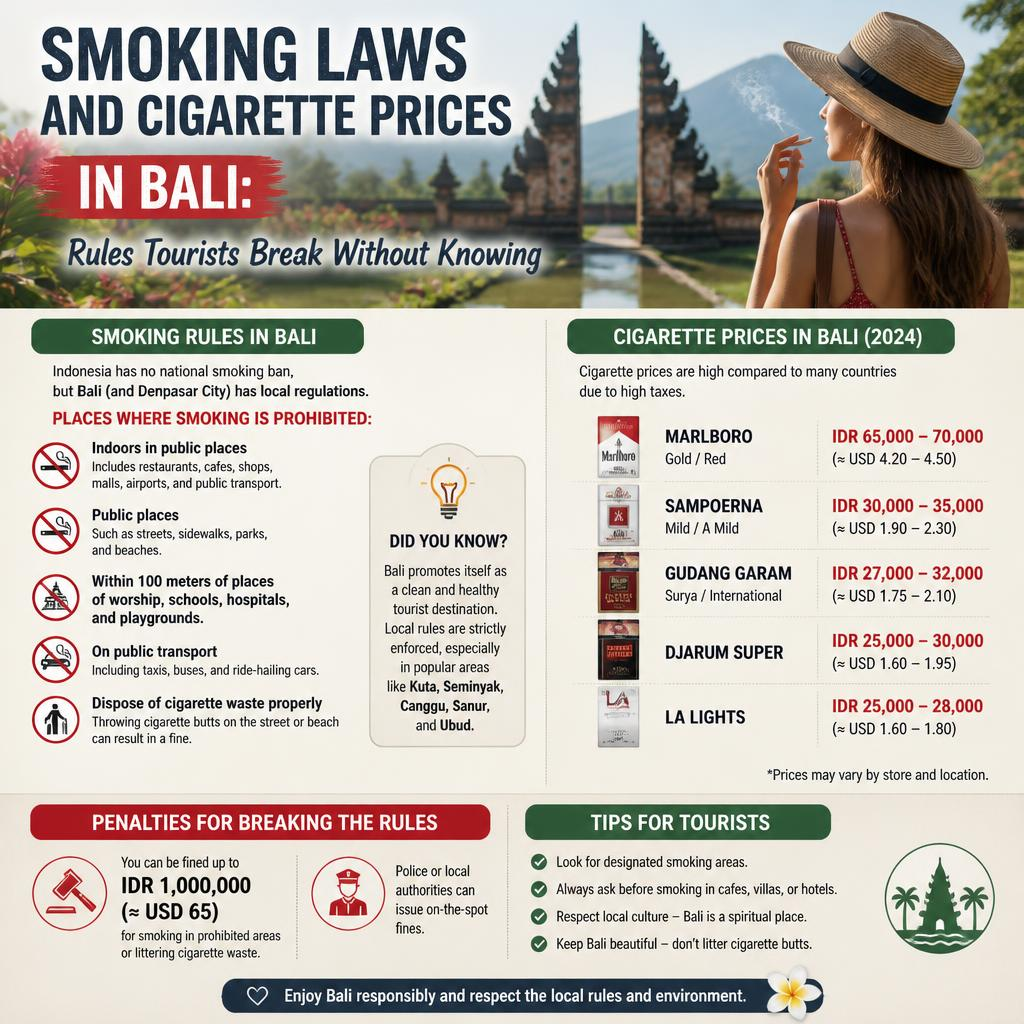
The Legal Framework for Smoking in Bali
Indonesia is simultaneously one of the world’s heaviest-smoking nations and one with a surprisingly detailed anti-smoking regulatory framework. This contradiction defines the reality tourists encounter in Bali: smoking is ubiquitous and normalised in Indonesian culture, yet formal laws restricting where you can smoke exist at both national and regional levels.
The primary national regulation is Government Regulation No. 109/2012 on Tobacco Products, which mandates smoke-free designations for a range of public spaces. At the provincial level, Bali has its own regional regulation (Perda) No. 10/2011 on Smoke-Free Areas, which defines the specific zones and penalties applicable within Bali Province.
These laws apply to all persons on Bali — tourists included. The fact that local enforcement is inconsistent does not mean the rules are unreal. Bali’s tourism authority has increased enforcement focus in culturally significant areas after several high-profile incidents where tourists were photographed smoking at temples.
Complete List of Smoke-Free Zones in Bali
Bali’s smoke-free zone designations cover a broad range of locations. These are not advisory guidelines — they are designated legal prohibitions under Perda No. 10/2011.
Category A: Absolute Prohibition (No Smoking Anywhere Within the Site)
- Hindu temples (pura): Every temple in Bali — from Pura Tanah Lot and Pura Uluwatu to Pura Tirta Empul and every neighbourhood temple (pura desa) — is a smoke-free zone. The prohibition extends to the temple grounds, outer courtyards (jaba sisi), and the area immediately surrounding the outer walls. This is both a legal requirement and a matter of deep religious respect for Balinese Hindus.
- Hospitals and health clinics: Including BIMC Kuta, Siloam Hospitals Bali, RSPB, and all puskesmas (community health centres). The prohibition applies inside and within the immediate premises.
- Schools (SD, SMP, SMA) and universities: All educational campuses, including the grounds.
- Children’s playgrounds and recreational areas designated for children.
- Indoor workplaces: Any enclosed workplace is formally a smoke-free zone. In practice, this is inconsistently applied in small local businesses but is enforced in corporate offices, hotels, and tourist-facing establishments.
- Public transport: Buses, bemos (local minibuses), and taxis (including Grab and Gojek vehicles).
Category B: Designated Indoor Spaces (No Smoking Without Designated Area)
- Restaurants and food establishments: Technically required to be smoke-free or to have a designated smoking area physically separated from the non-smoking section. In practice, many local warungs (small restaurants) allow smoking freely. International and upscale restaurants in Seminyak, Canggu, and Ubud are more consistently smoke-free.
- Hotels: Hotel lobbies, dining areas, and most public spaces within hotels are smoke-free. Rooms may be designated smoking or non-smoking. Smoking outside on a hotel terrace or designated outdoor area is generally permitted.
- Shopping malls and retail centres: Major malls including Beachwalk (Kuta), Bali Collection (Nusa Dua), and Discovery Kartika Plaza are smoke-free indoors with designated outdoor smoking areas.
- Government offices: No smoking in immigration offices, police stations, or any other government facility.
Beach Areas: The Expanding Grey Zone
Beaches in Bali have historically been permissive spaces for smoking — the open air, the casual tourist atmosphere, and the absence of formal signage made them functional free-smoking zones. This is changing. Badung Regency (covering Kuta, Seminyak, Legian, and Nusa Dua) has discussed expanded smoke-free beach regulations. Nusa Dua beaches, managed within a premium resort enclave, have stricter enforcement than Kuta. Sanur has some smoke-free beach designations.
As of 2026: smoking on most Bali beaches is not formally prohibited by an actively enforced specific regulation, but this is shifting. Expect the formal landscape to tighten over the next few years.
Fines and Enforcement Reality
The maximum fine for violating smoke-free zone regulations under Bali’s Perda is IDR 50,000 (approximately USD 3). Businesses that violate the designated smoking area requirements face higher fines — up to IDR 5,000,000 for establishments.
Where Enforcement Is Strict
- Temple grounds: Balinese Pecalang (traditional security volunteers who maintain order in and around temple areas) will ask you to stop and may remove you from the premises. This is the most consistently enforced smoke-free designation in Bali.
- Hospitals: Medical staff and security at major hospitals in Bali apply the prohibition firmly.
- Nusa Dua resort enclave: The Nusa Dua area management (BTDC — Bali Tourism Development Corporation) maintains stricter enforcement standards for tourist conduct within the resort enclave than elsewhere in Bali.
Where Enforcement Is Minimal
- Open streets and markets in Kuta and Denpasar: Practically no enforcement. Smoking on Kuta’s streets is ubiquitous among tourists and locals alike.
- Beach areas: No meaningful formal enforcement on most beaches.
- Local warungs: Many small local restaurants are effectively permissive regardless of formal requirements.
The practical reality is that the fine amount (IDR 50,000) is not a serious deterrent by itself — it is less than the cost of a coffee at many Bali cafés. What actually deters behaviour is the cultural and social friction of being asked to stop in a sacred or professional space, plus the potential for a situation to escalate into a broader confrontation or attract attention from local police.
Where Tourists Can Smoke Legally
Despite the formal restrictions, there are plenty of places where tourists can smoke without issue:
- Your hotel or villa terrace/balcony (unless specifically designated non-smoking)
- Open-air beach bars and restaurants that have smoking areas or no formal prohibition
- Most outdoor areas of bars and nightlife venues in Kuta, Seminyak, and Canggu
- Street-side and outdoor market areas
- Designated smoking areas in airports, malls, and hotels
- Open outdoor areas not designated as smoke-free
The simple rule: if you are indoors and unsure, ask. If you are at a temple, hospital, school, or government office, do not smoke regardless of whether you see a sign.
Cigarette Prices in Bali 2026
Indonesia has long been one of the world’s most affordable places to buy cigarettes. Tobacco taxes in Indonesia are lower than in Australia, the UK, or much of Europe, and locally produced cigarette brands have a manufacturing cost advantage. For many international tourists, Bali cigarette prices are genuinely striking.
Current Retail Prices (Approximate, 2026)
| Brand / Type | Price per Pack (IDR) | Price per Pack (USD Approx.) | Notes |
|---|---|---|---|
| Gudang Garam Surya (kretek) | IDR 28,000–35,000 | ~USD 1.75–2.15 | Indonesia’s iconic full-flavour kretek; 12 or 20 sticks per pack |
| Djarum Black (kretek) | IDR 28,000–36,000 | ~USD 1.75–2.20 | International kretek brand; widely exported |
| Sampoerna A Mild (mild kretek) | IDR 30,000–38,000 | ~USD 1.85–2.35 | Indonesia’s best-selling cigarette; lighter flavour |
| Marlboro Red (international) | IDR 45,000–60,000 | ~USD 2.75–3.70 | Widely available; produced locally under licence |
| Marlboro Gold / Lights | IDR 45,000–62,000 | ~USD 2.75–3.80 | Available at convenience stores and minimarkets |
| Lucky Strike | IDR 42,000–58,000 | ~USD 2.60–3.55 | Available at most minimarkets |
| Camel | IDR 42,000–55,000 | ~USD 2.60–3.40 | Common in tourist areas |
| Winston | IDR 40,000–52,000 | ~USD 2.45–3.20 | Good availability in south Bali |
| Hand-rolled cigarettes (rokok linting) | IDR 5,000–15,000 | ~USD 0.30–0.90 | Very local; found in traditional markets |
Prices vary between locations — minimarkets (Indomaret, Alfamart) in tourist areas may charge slightly more than the same cigarettes at a local warung in Denpasar. Duty-free shops at the airport offer further savings on international brands.
Price Comparison Context
To put Bali cigarette prices in perspective: a pack of Marlboro Red costs approximately AUD 50 in Australia, GBP 15 in the UK, USD 10–14 in the United States, and around USD 2.75–3.70 in Bali. For heavy smokers from high-tax countries, the price difference is significant. This is also why Bali’s cigarette duty-free allowance is worth using.
Duty-Free Allowances at Bali Airport
Indonesian customs permits each arriving adult to bring in the following tobacco products duty-free:
| Tobacco Product | Duty-Free Allowance |
|---|---|
| Cigarettes | 200 cigarettes (one carton, 10 packs of 20) |
| Cigars | 25 cigars |
| Pipe tobacco / loose tobacco | 100 grams |
| IQOS HeatSticks / TEREA sticks | 200 sticks (counted as cigarettes) |
You may only use one category — you cannot bring 200 cigarettes AND 25 cigars. It is one or the other (or you combine in proportions that total the equivalent of one category). Exceeding the allowance requires a declaration; undeclared tobacco is subject to confiscation and penalty.
Bali’s Ngurah Rai Airport duty-free shops, located past immigration and before baggage claim for arriving passengers (post-arrival duty-free), stock major international cigarette brands at competitive prices. Buying at the airport duty-free is often the cheapest source for international brands if you want to stock up.
Kretek: Indonesia’s Clove Cigarettes Explained
Kretek — pronounced “kreh-tek” after the crackling sound the cloves make when burned — is Indonesia’s signature cigarette and one of the most distinctive aspects of Indonesian smoking culture that tourists encounter in Bali. If you smell something that reminds you of a dentist’s office or a mild spice market when someone lights up near you, it is almost certainly a kretek.
What Makes Kretek Different
A kretek contains a blend of tobacco, cloves (cengkeh in Indonesian), and often proprietary sauce or flavouring additives. Cloves typically make up 20–40% of the blend. The clove eugenol provides a mild anaesthetic effect on the throat, which is why kretek smokers often describe them as smoother than pure tobacco cigarettes. The distinctive aroma — warm, sweet, spicy — is immediately recognisable.
Main Kretek Varieties Available to Tourists
- Full kretek (SKT — Sigaret Kretek Tangan, hand-rolled): Traditional hand-rolled kreteks with a higher clove content. Brands: Djarum Coklat, Gudang Garam Merah. Stronger, more aromatic. These are the oldest form.
- Machine-rolled kretek (SKM — Sigaret Kretek Mesin): Factory-produced kreteks, more consistent, often with filter. Brands: Gudang Garam Surya, Sampoerna Kretek, Djarum Super. Most common variety sold to tourists.
- Mild kretek (Low-Tar): Lighter blends with filter. Brands: Sampoerna A Mild (best-selling cigarette in Indonesia), Gudang Garam Mild, LA Bold. These are marketed to younger and health-conscious smokers.
- Premium kretek: Higher-priced blends with premium tobacco. Brands: Djarum Black (iconic internationally), Gudang Garam Signature.
Should Tourists Try Kretek?
Kretek is a genuine piece of Indonesian culture and many tourists try one out of curiosity. Be aware that full kreteks (especially hand-rolled varieties) are significantly stronger and more aromatic than most Western cigarettes. The eugenol anaesthetic effect means the harshness is masked — you may be inhaling more deeply than you realise. For occasional curiosity, there is nothing preventing an adult tourist from trying a kretek. For people with respiratory conditions or clove sensitivities, they are worth avoiding.
Where to Buy Cigarettes in Bali
Cigarettes are available essentially everywhere in Bali:
- Minimarkets (Indomaret, Alfamart): Ubiquitous across Bali; stock major local and international brands. Open 24 hours.
- Warungs (local small shops): Stock local kreteks, sometimes individual cigarettes sold by the stick (rokok batangan) for extremely low prices.
- Convenience stores in tourist areas: Circle K, 7-Eleven (limited in Bali), and similar stores stock international brands.
- Duty-free at Ngurah Rai Airport: Best prices for international brands on arrival or departure.
- Markets (pasar): Traditional markets like Pasar Badung in Denpasar stock cheaper local products.
Health Warnings and Cultural Context
Indonesian cigarette packs carry graphic health warning images covering 40% of the pack’s front surface — one of the more extensive warning requirements in Southeast Asia. These warnings are in Bahasa Indonesia. The warnings include images of cancer symptoms, diseased lungs, and sick children. They are unavoidable when purchasing cigarettes locally.
Indonesia’s smoking rate is among the highest in the world for adult males — approximately 65–70% of Indonesian men smoke. This cultural normalisation means you will encounter cigarette smoke in many spaces where non-smokers from Western countries might be surprised to see it — at some warung restaurants, in certain hotel lobbies, or in the homes of Balinese families. The cultural attitude toward smoking in Indonesia is notably different from increasingly smoke-free cultures in Australia, Europe, or parts of the United States.
For tourists from heavily smoke-free environments, it helps to calibrate expectations: while formal smoke-free zones exist and are legally real, the broader Indonesian culture is more accepting of ambient cigarette smoke than you may be accustomed to. This is not a reason to ignore the rules — it is context for understanding why local enforcement is inconsistent.
See our guide to Bali customs rules for the complete picture of what you can and cannot bring into Indonesia. And if you are a vaper rather than a cigarette smoker, our dedicated vape and e-cigarette rules guide for Bali covers everything specific to vaping devices and liquids.